Best Keyword Clustering Tools for SEO in 2026


Choosing the right keyword clustering tools in 2026 comes down to matching your workflow to one of five standouts: Keyword Insights, LowFruits, Ahrefs Keywords Explorer, SEMrush Keyword Strategy Builder, and Search Atlas Content Planner. Each wins a different race — agency scale, solo budgets, data depth, integrated campaigns, or AI speed.
I'm Max Long, and after years helping marketing teams untangle their content operations, I've watched too many marketers waste weekends sorting keywords by hand. The fix isn't more hustle. It's the right tool paired with a repeatable process.
This guide cuts through the noise. You'll see which tools fit which situations, where free options hold up, and where paid automation pulls ahead. Let's start with a quick side-by-side look at the top five.

Top keyword clustering tools at a glance
Drowning in spreadsheets of keywords that all kind of mean the same thing? You're not alone. Most marketers waste hours trying to sort terms into content buckets manually — and the results are usually messy.
Here's the thing: the right tool cuts that work from days to minutes. After testing dozens of options, five keyword clustering tools stand out in 2026, each built for a different workflow and budget.
Attribute | Keyword Insights | LowFruits | Ahrefs KE | SEMrush KSB | Search Atlas |
|---|---|---|---|---|---|
Best for | Agencies, scale | Solo marketers | Data depth | All-in-one teams | Content planning |
Method | SERP-based | SERP-based | Hybrid | SERP + NLP | AI-assisted |
Starting price | Mid-tier | Budget | Higher tier | Higher tier | Mid-tier |
Speed | Fast | Moderate | Fast | Fast | Very fast |
Free tier | Trial | Credits | Limited | Limited | Trial |
Keyword Insights is the go-to for agencies handling large keyword sets. Its SERP-based clustering groups terms by what Google actually ranks — not just semantic similarity — so you'll typically get clusters that map cleanly to real pages.
LowFruits targets solo marketers and bootstrapped founders. It's credit-based, affordable, and strong at surfacing low-competition terms. Think of it as a keyword command center for people who can't justify a four-figure annual subscription.
Ahrefs Keywords Explorer appeals to SEOs who want clustering alongside deep backlink and ranking data. The clustering features sit inside a bigger toolkit, which is great if you're already paying for it.
SEMrush Keyword Strategy Builder works best for in-house teams running full-funnel campaigns. It pairs clustering with competitor gaps and content briefs — useful when one platform needs to feed an editorial calendar.
Search Atlas Content Planner leans heavily into AI-assisted workflows. It's the fastest option here and ties clusters directly to content outlines, which suits lean teams pushing volume.
Matching the tool to your situation matters more than picking the "best" one. A solo marketer shouldn't pay agency prices. An agency shouldn't rely on a credit-based tool built for small projects. Think about your monthly keyword volume, team size, and whether clustering is a standalone task or part of a bigger SEO workflow.
Bottom line: there's no single winner — pick the tool that fits your budget, volume, and how you actually turn clusters into content.
Before diving into detailed reviews, it helps to understand exactly what keyword clustering is and why it should sit at the core of your SEO strategy.
What is keyword clustering (and why it matters)
Ever published three blog posts on similar topics and watched them all underperform? That's usually a clustering problem.
Keyword clustering is the practice of grouping keywords by shared search intent. Instead of building one page per keyword, you build one page per cluster — a tight set of terms that all deserve the same answer. A cluster around a specific shoe type might pull in several closely related search variants covering the same underlying need. Same intent, same page.
Here's the thing: Google doesn't rank keywords. It ranks pages against user intent. When your page satisfies a whole cluster, you rank for dozens of terms at once.
Three benefits make this approach worth your time.
Topical authority comes first. When your site covers a subject from every angle — pillar page plus supporting articles — search engines treat you as a credible source. You're not just ranking for one term; you're owning the topic.
Second, clustering cuts keyword cannibalization. That's when two of your own pages compete for the same search. Google gets confused, splits the ranking signals, and neither page wins. Group those keywords into a single cluster and you consolidate the authority into one winning page.
Third, you get better content ROI. Writing many thin posts to chase individual keywords is exhausting and rarely works. Writing fewer strong pages that each target a cluster of related keywords provides better leverage. Your editorial calendar gets simpler too.
A quick example: say you run a bookkeeping software company. Without clustering, you might write separate posts on "small business accounting," "accounting for small business," and "small business bookkeeping" — and watch them cannibalize each other. With clustering, they become one comprehensive guide that ranks for all three.
The shift in thinking matters. You stop treating keyword research as a list-building exercise and start treating it as content architecture. Your SEO tools — whether free or paid — exist to support that architecture. For a deeper look at how clustering fits into broader search strategy, see the SEO benefits of keyword clustering.
Bottom line: clustering turns scattered keywords into focused pages that rank harder and earn more with less content.
Now that you know what keyword clustering delivers, here is exactly how we assessed each tool before recommending it.
How we evaluated these SEO keyword clustering tools
Picking a keyword clustering tool without a rubric is how marketers end up paying for software they never use. So before recommending anything, we built a six-criteria scorecard and ran every platform through the same gauntlet.
Here's the thing: no single tool wins every category. The goal wasn't to crown a champion — it was to match strengths to workflows.
Clustering method came first. We looked at how each tool actually groups keywords: SERP-based (comparing which URLs rank for each term), NLP-based (analyzing semantic similarity between words), or rule-based (manual logic like exact-match roots). SERP-based methods tend to produce clusters that mirror Google's actual intent reading. NLP runs faster and scales bigger but can misfire on ambiguous terms.
Accuracy was next. We fed each tool the same seed list of keywords across several niches and checked whether the output clusters made editorial sense. Could a writer take a cluster and draft one coherent page? Or did we see terms with clearly different intent lumped together?
Speed mattered for agency and high-volume workflows. We timed processing for large keyword batches and flagged anything too slow for agency workflows.
Ease of use covered onboarding, interface clarity, and export options. A tool that takes three hours to learn isn't saving you time.
For pricing and free tier availability, we logged starting costs, credit-based vs. subscription models, and whether you can test real output before paying. A free tier that caps at 50 keywords is marketing; one that handles 500 is useful.
Finally, AI features — how each platform applies LLMs to intent labeling, content brief generation, or automated pillar-spoke mapping. AI features shouldn't be a gimmick. They should shave hours off downstream work.
We tested on live projects, not demo data. Does a tool that looks great in screenshots hold up when you're clustering thousands of keywords for a real client on a Tuesday deadline?
One stance worth naming: we're skeptical of tools that only publish NLP results. Without a SERP check, you're trusting the algorithm's guess over Google's actual behavior. The best keyword clustering tools blend both — and that blend is what this keyword clustering tools comparison 2026 surfaces in the next section.
Bottom line: match the tool to your workflow, budget, and volume — not to the loudest marketing.
With that framework in place, here are the five tools that rose to the top of our testing.
The 5 best keyword clustering tools (tested)
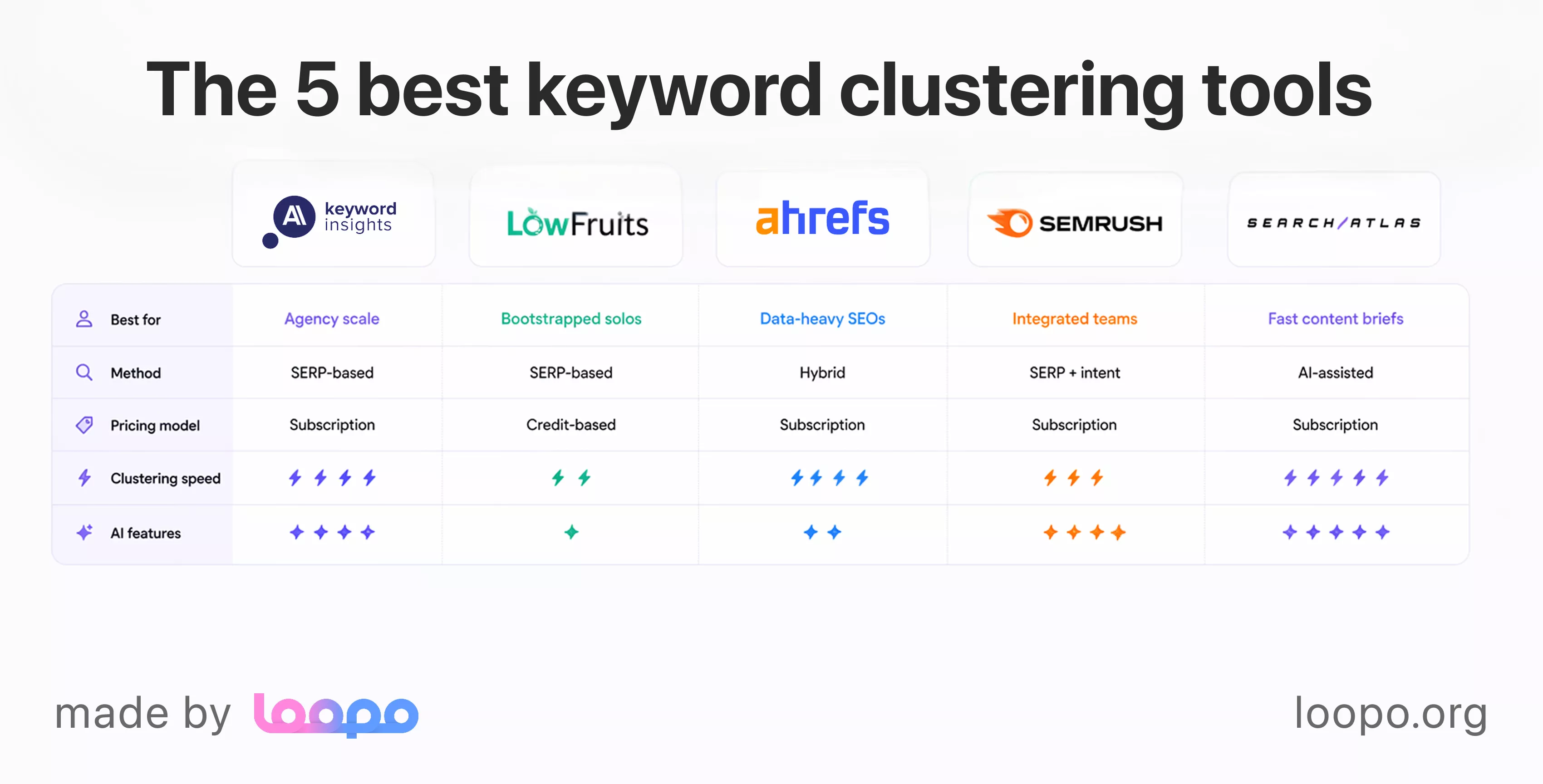
After our six-criteria test, five tools rose to the top — each winning a different category.
Tool | Keyword Insights | LowFruits | Ahrefs KE | SEMrush KSB | Search Atlas |
|---|---|---|---|---|---|
Best for | Agency scale | Bootstrapped solos | Data-heavy SEOs | Integrated teams | Fast content briefs |
Method | SERP-based | SERP-based | Hybrid SERP+NLP | SERP + intent | AI-assisted |
Pricing model | Subscription | Credit-based | Subscription | Subscription | Subscription |
Clustering speed | Fast | Moderate | Fast | Fast | Very fast |
AI features | Strong | Light | Moderate | Strong | Native |
Keyword Insights is the most accurate SERP-based option we tested. Feed it a large keyword list and clusters tend to map cleanly to real pages. Built for agencies running weekly cluster jobs. Pros: clean exports, intent labels, pillar-spoke suggestions. Cons: pricing climbs fast at high volume.
LowFruits is the answer for solo marketers and bootstrapped founders. Credit-based, so you pay for what you use — a content command center sized for smaller projects. It shines at surfacing low-competition terms inside clusters. Cons: slower on large keyword jobs, fewer automation hooks.
Ahrefs Keywords Explorer adds clustering to its broader research and backlink toolkit. If you already pay for Ahrefs, these clustering tools for SEO save you a second subscription. The hybrid method blends SERP overlap with semantic signals. Cons: the workflow can feel bolted on.
SEMrush Keyword Strategy Builder wins for teams wanting clustering tied to competitor gaps and briefs. Which tools do keyword clustering automatically? SEMrush is among the strongest. Cons: overwhelming if you only need clustering.
Search Atlas Content Planner is the speed champion and leans hardest into AI. Clusters process in seconds and feed directly into briefs. Cons: AI-first clustering trades some SERP accuracy for speed.
Pick based on workflow, not reviews. An agency clustering tens of thousands of keywords monthly shouldn't use LowFruits. A solopreneur with a small list shouldn't pay for SEMrush. Match capacity to volume, then fit clusters into your content strategy framework so outputs hit the editorial calendar.
Start a free trial — most tools for automatic keyword clustering offer one, so test real output before committing.
Bottom line: the best keyword clustering tools win different races — pick the one matching your budget, volume, and workflow.
If budget is tight, several free and freemium options are worth considering first.
Free keyword clustering tools worth using
Tight budget? You've got options. Free keyword clustering tools can handle real work — they just come with trade-offs you need to know upfront.
Here's the thing: free tools shine on small projects. Once you hit serious volume, paid automation pulls ahead.
Feature | Keyword Cupid | KeywordClustering.net | ChatGPT manual | Pemavor |
|---|---|---|---|---|
Best for | Small projects | Quick clusters | Custom logic | Batch jobs |
Method | SERP-based | SERP-based | LLM reasoning | SERP-based |
Volume cap | Low free tier | Daily limits | Context window | Credit limits |
Automation | Light | Light | Manual prompts | Moderate |
Keyword Cupid offers a limited free tier that's useful for testing output quality before you commit. It uses SERP-based clustering, so results tend to map cleanly to how Google groups intent. A solid starting point for solo marketers.
KeywordClustering.net is the no-signup option. Paste your list, get clusters back. Think of it as a quick command center for one-off research — not something you'd build a recurring workflow around.
The ChatGPT manual clustering approach is surprisingly effective when you write the right prompt. You feed in your keyword list, ask GPT to group by intent, and refine from there. The catch? You're doing the SERP validation yourself, and context windows cap how many terms you can cluster at once. Great for a small list, painful for a large one.
Pemavor's free clustering tool handles modest batches with SERP-based logic. It's straightforward and gets the job done for keyword research on smaller sites.
Here's where free hits its ceiling: volume caps and automation limitations vs. paid tools. Free versions typically limit you to a few hundred keywords per run. You'll lose features like automated pillar-spoke mapping, bulk exports, intent labeling, and integrations with your editorial calendar. If you're clustering thousands of terms weekly for clients, you'll burn more hours fighting limits than you'd spend on a subscription.
Which tools do keyword clustering automatically at a free tier? Keyword Cupid and Pemavor get closest, but "automatic" has caveats — expect manual re-runs and smaller batch sizes.
In most cases, the smartest path is to start free to learn the workflow, then upgrade when volume or client demands justify it. Pair these free tools with your broader inbound marketing tools stack so clustering feeds directly into content planning.
Bottom line: free keyword clustering tools work for low-volume projects, but paid alternatives win on automation, scale, and time saved.
Beyond free-vs-paid distinctions, one of the most significant shifts in 2026 is how AI has changed what clustering tools can do automatically.
AI keyword clustering: what's changed in 2026
If you clustered keywords two years ago and haven't looked since, the ground has shifted under you. LLM-based tools now do in seconds what used to take afternoons.
Here's the thing: fast doesn't always mean better. Understanding the trade-off is what separates marketers who get real SEO lift from those chasing shiny tools.
LLM-based vs. SERP-based clustering is the core split. SERP-based methods compare which URLs actually rank for each keyword, then group terms Google already treats as related. LLM-based methods read keywords semantically and guess which ones share intent. Different logic, different results.
The speed advantage of AI keyword clustering tools is real. Feed thousands of keywords into an LLM and you'll get clusters back before your coffee cools. SERP-based tools have to query search results for every term, which takes longer at scale. For agencies processing large volumes weekly, automated keyword clustering tools powered by LLMs change the economics of content creation entirely.
But here's where you need to pay attention: accuracy trade-offs matter. LLMs sometimes group keywords that sound similar but rank on completely different SERPs. Two terms might read as synonyms while Google treats them as distinct. A semantic guess misses what a SERP check catches. For high-stakes pages, that gap costs real traffic.
ChatGPT works as a manual AI clustering option. Paste a list, write a prompt, get groupings back. Good for small batches. Writesonic offers AI clustering features inside a broader content suite — useful if you're already in that ecosystem.
Where things get interesting is native AI inside purpose-built tools. Keyword Insights layers LLM intent labels on top of SERP-based clusters — you get the speed boost without losing accuracy. SEMrush's Keyword Strategy Builder uses AI for content brief generation once clusters are set. Search Atlas leans hardest into AI-first clustering, trading some precision for output speed that suits content-heavy workflows.
Which approach wins? Neither, alone. The best workflow in 2026 typically uses SERP-based clustering for the core grouping, then applies AI for intent labels, brief generation, and pillar-spoke mapping. That's the hybrid approach most AI-powered marketing tools now default to.
Don't let speed become an excuse to skip validation. Spot-check AI outputs against actual SERPs before committing clusters to your editorial calendar.
Bottom line: AI clustering saves hours, but SERP validation keeps those hours from becoming wasted rankings.
Knowing which tools to use is only half the battle — how you apply clustering data to your content process determines the actual SEO lift you see.
Pro tips to maximize your keyword clusters
Clusters sitting in a spreadsheet don't move rankings. Clusters that drive your content decisions do. Here's where most marketers leave value on the table.
Tip 1: Use clusters to build pillar-spoke content models for topical authority
Think of it as a hub and its satellites. Your pillar page covers the broad topic; spoke pages target individual clusters that feed back into it through internal links. Google reads this structure as expertise. You rank for more terms with less content.
Say you run a meal-prep service. Pillar: "meal prep for beginners." Spokes: clusters around "meal prep containers," "meal prep on a budget," "high-protein meal prep." Each spoke links up; the pillar links down.
Bottom line: one pillar plus five to eight spokes beats twenty scattered posts.
Tip 2: Run content gap analysis with cluster data
Export your cluster list, then map it against what you've already published. You'll see holes — clusters with no matching page, or clusters you half-covered in an old post. This is faster than auditing keywords one by one.
Pair it with competitor cluster analysis. Which clusters do they own that you've ignored? That's your keyword research shortlist for next quarter's content marketing calendar.
Tip 3: Let clusters guide internal linking strategy
Your links should follow your cluster logic. Every spoke post links to its pillar. Related spokes link to each other. This reinforces topical relevance and distributes authority across the group. For a deeper look at performance signals, check organic search analytics.
Don't just link randomly. Build a simple matrix: pillar in column A, spokes in column B, cross-links between spokes in column C. Update it whenever you publish.
Tip 4: Refresh old content using cluster insights
Got a post from a couple years back that's underperforming? Check which cluster it belongs to. Often the old post targeted one keyword when it should've addressed several. Expand it to cover the whole cluster — add sections for the missing terms, update examples, tighten the intro.
You'll often see ranking lifts within weeks. A targeted refresh beats a full rewrite when the foundation is already there.
One more thing: tie this back to your overall product marketing framework so content creation decisions connect to business goals, not just search volume.
Bottom line: clusters earn their keep when they shape architecture, gaps, links, and refreshes — not when they sit in a spreadsheet.
Beyond published frameworks and best practices, here is what we have seen work — and fail — when applying keyword clustering tools in real campaigns.
Our experience with keyword clustering tools: lessons from real campaigns
After running dozens of content campaigns with different keyword clustering tools, one pattern keeps showing up: the tool matters far less than what you do with the output.
Here's the thing: we've watched teams buy the most expensive SEO tools on the market and still miss their traffic goals. We've also watched scrappy solo marketers using free alternatives build real topical authority. The difference? Consistency.
You can export the cleanest cluster report in the world, but if it never makes it into your editorial calendar, it's a $200 spreadsheet gathering dust.
Early on, we made the mistake most teams make. Cluster everything. Celebrate the output. Move on. Then we'd check back three months later and realize only a small fraction of the clusters had become actual pages. The rest? Forgotten.
What changed things was treating cluster outputs like a queue, not a library. Every Monday, one cluster gets assigned to a writer. Every cluster assigned gets mapped to a pillar or spoke slot on the site. Every published piece gets internal-linked back to its cluster family within 48 hours. Boring? Yes. Effective? Also yes.
The second lesson was harder: clusters don't age well when ignored. Search intent shifts. A cluster that made sense in Q1 can drift by Q4 as Google recalibrates what ranks for a term. We now re-cluster core topics every six months — not every keyword, just the commercial ones driving revenue.
We've also learned to trust our own judgment over the tool's verdict. Even the best keyword clustering tools occasionally group terms that share words but not intent. A quick SERP check — literally opening two tabs and comparing ranking pages — saves you from publishing content that'll never rank.
One more thing: don't skip the basics. If your site architecture is broken, or your internal linking is random, no clustering tool will fix that. We've seen brands fall into common mistakes beginner bloggers make with SEO even after investing heavily in premium platforms. Foundations first, tools second.
The marketers who win at content marketing with clustering treat it as an operational discipline. Cluster. Assign. Publish. Link. Refresh. Repeat. The tool is the wrench; your process is the mechanic.
Bottom line: pick a clustering tool that fits your workflow, then obsess over applying the output consistently — that's where the ranking lift actually lives.
Below are quick answers to the questions about keyword clustering tools that come up most often.
Wrapping up: picking your keyword clustering tool
You've seen the tools, the trade-offs, and the real-world lessons. So what now?
Here's the thing: the winner isn't a platform — it's a process. Pick the tool that fits your volume and budget, then commit to turning clusters into pillar pages, spoke posts, and internal links every single week. That's where rankings actually come from.
A solo marketer with a small keyword list should start free and upgrade when volume demands it. An agency juggling thousands weekly needs SERP-based automation from day one. Match the tool to the job.
Want more playbooks on content operations, SEO workflows, and editorial systems that stick? Browse our blog for deeper guides.
Start your free trial and manage all your content in one place.
Bottom line: the right tool plus a boring, consistent process beats the fanciest platform every time.