How to Create a Content Brief (Step-by-Step)


How do you create a content brief? You write a single document that hands your writer the audience, keywords, structure, tone, and technical SEO details before they draft a word. That's the whole job: swap guesswork for direction, and the revision pile stops growing.
Most messy drafts aren't a writer problem — they're a briefing problem. When someone has to guess at the goal or the reader, you pay for it in revision rounds. A sharp brief fixes that upstream, and it works for blog posts, landing pages, social content, even infographics.
You'll get the full process here: what belongs inside, a ready-to-use template, the software worth your time, and the small details that decide rankings. First, let's nail down exactly what a content brief is.

What is a content brief?
A content brief is a strategic document that hands writers everything they need before they write a single word. Think of it as a roadmap: audience, keywords, structure, and tone, all spelled out upfront.
Here's the thing: most messy drafts aren't a writer problem. They're a briefing problem. When a writer has to guess at the goal or the reader, you get rewrites. Lots of them.
So what is a content brief actually doing for you? It keeps every piece pointed at your marketing strategy and cuts the back-and-forth that eats your week. Learning how to create a content brief is the fastest way to kill wasted revisions and ship content that ranks.
And content briefs aren't just for long-form blog posts. The same document works for landing pages, social posts, even infographics. Anything a creator touches benefits from clear direction.
One more reason they're worth the effort: adoption is already high. Most content marketers work with a brief, which tells you something about the benefits of SEO discipline.
Treat the brief as a real step in your workflow, sitting right after research and before writing. Not an afterthought you scribble in a Slack message.
Bottom line: a good brief replaces guesswork with direction. Now that you know what a content brief is, here's why skipping one in 2026 is a costly mistake for your SEO.
Why content briefs matter for SEO in 2026
A strong brief does three things at once: it cuts revision cycles, locks every piece to search intent, and hands you a ranking edge. Teams with structured briefs typically report cutting revisions by 50 to 60%. That's hours back in your week, not minor housekeeping.
Here's the thing: most rewrites come from vague direction, not lazy writers. Give them a real plan and approvals speed up fast.
Now factor in the AI flood. An Ahrefs study of 900,000 pages found 74.2% of newly created web pages contain AI-generated content. When that much sameness hits the SERPs, a sharp brief is what separates your page from the noise.
Brief quality is the lever, not editing. It predicts AI content ranking performance with 3x more accuracy than post-generation editing time. Raw AI drafts without structured review average a 35% bounce rate, versus 22% for reviewed content. So why pour hours into cleanup when the upstream input decides the outcome?
Want this working across every piece you publish? Build it into your wider content strategy brief and pair it with a repeatable content strategy framework.
Understanding why briefs matter is step one — now let's break down exactly what belongs inside a high-performing SEO content brief.
Key elements of a strong SEO content brief
Every effective SEO content brief covers the same handful of components. Skip one and you leave a gap your writer fills with guesswork. Guesswork is where rankings die.
Not all elements carry equal weight. According to a Databox study, the SEO-focused pieces matter most — primary and semantically related keywords, a content outline, and internal and external links. These signals help search engines understand your page.
So what makes the cut? A real content brief needs:
Business goal and search intent
Target audience and persona detail
Keywords labeled with intent and placement notes
A suggested H2/H3 outline with word count guidance
Voice, tone, and a clear list of things to avoid
Technical SEO: meta title, description, slug, internal links, alt text
Why does intent sit so high? Pages that mismatch search intent see bounce rates above 70%, while intent-aligned content typically keeps users engaged three to four times longer.
This isn't a vague SEO content brief template with empty boxes. Each field answers a question your writer would otherwise invent an answer to. A solid content writing brief template removes that guessing entirely.
Let's walk through each element.
Business goal and search intent
Start every SEO content brief by answering two questions. What action should the reader take? And what ranking outcome do you expect?
Name the desired action clearly. A demo signup, a newsletter join, a product comparison click — pick one.
Then map the piece to a specific intent type: informational, commercial, navigational, or transactional. A how-to guide is informational; a "best CRM" roundup is commercial.
Here's the thing: intent mismatch is where most competitor briefs fall apart. They chase keywords and forget what the searcher actually wants. Nail intent and you're already ahead.
Once you've nailed the goal and intent, you need to tell your writer exactly who they're writing for.
Target audience and persona details
Don't just write "marketers." Spell out the reader's role, pain points, and knowledge level. A VP of sales and a junior coordinator need totally different copy.
Vague audience notes push writers toward generic copy that serves no one. Specific notes produce sharper writing. It's that simple.
This matters more when outsourcing to freelancers. They don't sit in your meetings, so the brief is all they have. Give external writers more context — the same goes when structuring your content team.
Keywords with explicit user intent
Don't dump a raw keyword list into your SEO brief template. Label each term with its intent — informational, commercial, transactional — plus a quick note on why it's there.
Add placement guidance: primary keyword in the H1 and intro, secondary terms in subheads, semantic terms throughout the body.
Pull semantic and LSI terms from top-ranking pages. Keyword clustering tools make grouping faster.
One more flag: list keywords to avoid so two pages don't cannibalize each other.
Next, a suggested content structure cuts revisions.
Suggested outline and content structure
Hand your writer a section-by-section skeleton. Pencil in each H2 and H3 with a one-line note on what it must cover. This single move typically saves multiple revision rounds.
Add word count guidance per section, and benchmark the total against the pages already ranking — not an arbitrary number you picked. If the top three results average 1,800 words, aiming for 600 won't cut it.
A basic wireframe in your content brief template removes the guesswork that stalls drafts.
Structure tells writers what to write — tone guidelines tell them how to write it.
Voice, tone, and things to avoid
Spell out your brand voice in concrete terms. "Confident and direct, not academic" tells a writer more than "professional" ever will.
Then flag what NOT to include. Name the competitors you won't mention, the unverifiable claims to skip, the outdated data to avoid, and any off-brand phrases that make you wince.
These flags prevent the costly edits that kill publishing momentum. Link your brand and style guides right in the SEO briefing template so writers can self-serve on voice questions.
Beyond tone, there's one more layer most briefs overlook entirely: the technical SEO requirements your writer needs to handle before hitting publish.
Technical SEO and on-page requirements
Spell out on-page details in the brief, not as cleanup later. Your SEO content brief should specify these:
Meta title: under 60 characters, primary keyword near the start.
Meta description: 140 to 160 characters, active, benefit-focused, primary keyword included.
URL slug: hyphens between words, no stop words, mirroring your primary keyword.
Internal links: give exact anchor text and target URL, not "add some links."
Image alt text guidance, plus schema markup if it fits.
Writers who don't see these requirements leave gaps. Spelling them out closes those gaps before publish.
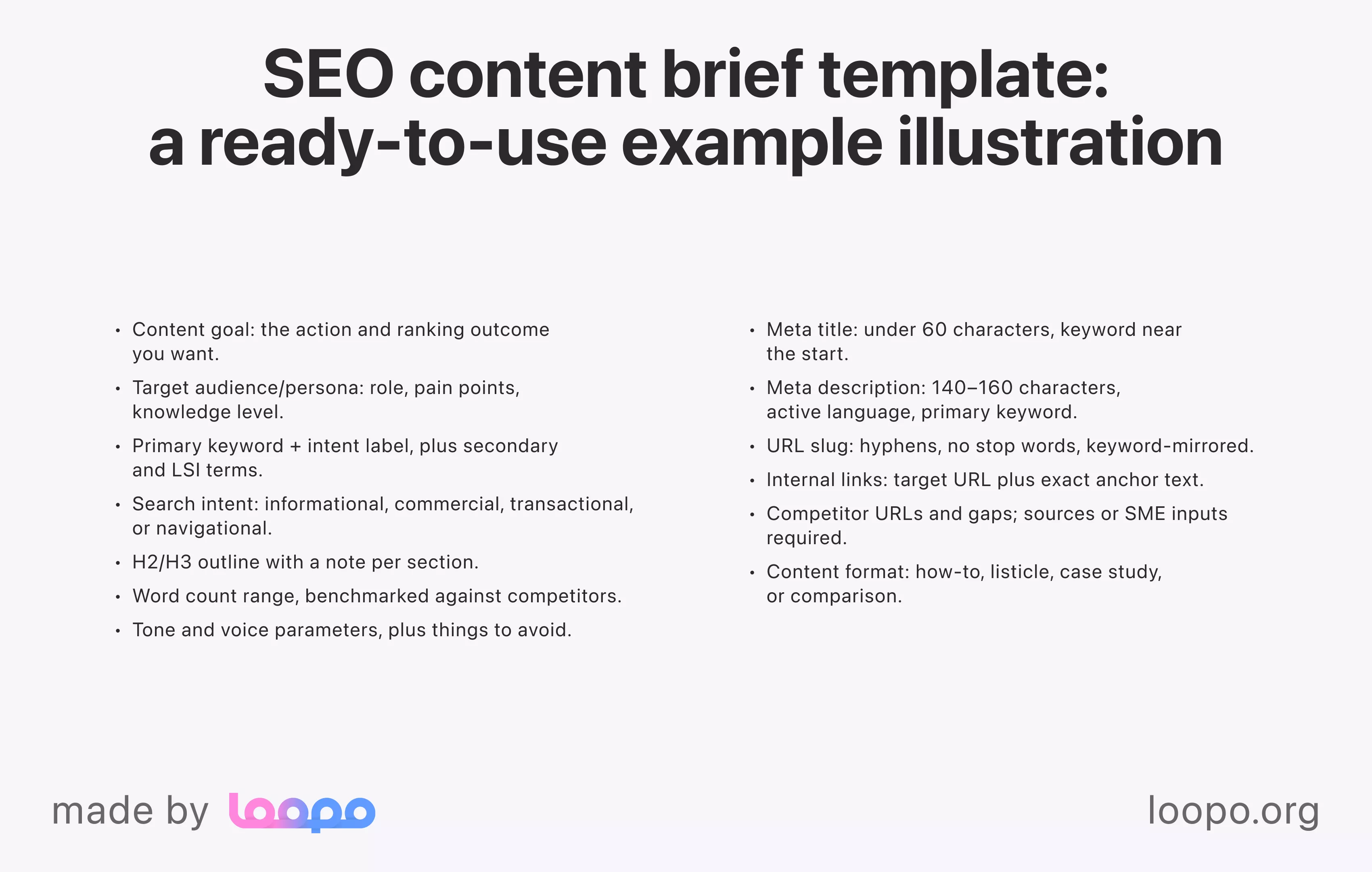
Want a quick blog post brief? Trim to goal, audience, keywords, outline, and metadata. That SEO content brief example works for most posts, and it's smart when planning content marketing for startups.
Looking for more content brief examples? This structure scales to any format.
Start your free trial and manage all your content in one place.
Several tools automate parts of this process to speed up brief creation.
Content brief software worth considering
A few tools can automate SERP research and brief generation at scale. Even the best content brief software, though, produces weak output without a clear strategic input.
Surfer SEO is your pick for real-time on-page optimization and SERP-driven briefs. Content Harmony shines for strategist-writer handoffs, with deep keyword clustering and a brief built for separate roles. Frase suits smaller teams wanting AI-assisted research, and it added GEO scoring alongside traditional SEO scoring. MarketMuse models topic authority across your whole site. Managing the workflow around those briefs? Loopo handles that side.
Attribute | Surfer SEO | Content Harmony | Frase | MarketMuse |
|---|---|---|---|---|
Best for | On-page optimization | Strategist handoffs | Smaller teams | Site-wide strategy |
Brief style | SERP-driven scoring | Keyword clustering | AI research + GEO | Topic authority |
Writing inside tool | Yes | No, handoff | Yes | No |
So which one wins? None of them, on their own. Brief quality predicts ranking performance roughly 3x more than post-generation editing — tools help, but strategy wins. The proof is in the ranking data: AI-assisted content with substantive human editing performs within 4% of fully human-written content.
Tools help you scale, but the real gains come from treating brief creation as a system you continuously improve — here's how to do that.
How to improve your brief process over time
The teams that win treat their content briefs as a living system, not a one-off task per piece. They refine, then refine again. Knowing how to create a content brief is step one; improving the process is what compounds.
Start by tracking which briefs produce top-ranking pages. Feed that performance data back into your template. Tracking organic search performance tells you which sections and structures actually earn rankings.
Then gather writer feedback after every project. Writers surface brief gaps faster than any analytics tool, because they hit the unclear parts first. Ask them directly: what slowed you down?
Run a quarterly template audit. Pull both your performance data and your team's notes into one review, and update the content strategy brief to match how search behaves now.
Don't forget old pages, either. Updating outdated posts with refined briefs is how one Ahrefs case study hit traffic gains as high as 468%. Systematic iteration does that. Brief quality compounds — the more you refine, the faster your team moves and the fewer revisions you need.
Beyond process frameworks, here's what we've personally observed separates high-performing briefs from those that consistently produce mediocre content.
What actually moves the needle with content briefs
Across hundreds of content briefs, the same patterns show up. The small details most teams skip are exactly the ones that decide whether a piece ranks or stalls.
The intent label does more heavy lifting than any other field. When a brief names the search intent clearly, writers stop guessing and the first draft lands close to final. Skip it, and you'll burn two extra revision rounds every time.
The second pattern? Specific internal link instructions. Briefs that hand the writer exact anchor text and target URLs produce pages that actually connect to the rest of the site. Vague "add some links" notes get ignored, in most cases completely.
What stalls content most often is a missing "things to avoid" list. Without it, writers reach for outdated stats or off-brand phrasing, and you pay for it in edits.
One more lesson worth your attention: a strong brief feeds your content distribution strategy too, because clear positioning makes a piece easier to promote later.
None of these are fancy. They're just the fields teams treat as optional — and shouldn't.
Put everything above into practice and you'll have a brief process that consistently produces content worth publishing — here's a quick summary of the key takeaways.
Bringing it all together
You came here to learn how to create a content brief. Now you've got the full picture: the elements, a ready-to-use template, the software options, and the small details that decide rankings.
A brief is only worth the time it saves. Start simple. Pick your next post, fill in goal, audience, keywords, outline, and metadata, then hand it off. Watch the revisions shrink.
Refine as you go. Feed performance data and writer feedback back into your template every quarter. Want more tactical playbooks like this one? Our team publishes them regularly over on our blog.
Ready to put it into action without juggling a dozen disconnected tools? Start your free trial and manage all your content in one place.
Bottom line: clear briefs in, better content out.