B2B Content Marketing Funnel: A Complete Guide


A B2B content marketing funnel maps specific content assets to three buyer stages — TOFU for awareness, MOFU for evaluation, and BOFU for decision — so prospects get the right asset at the right moment instead of generic noise. Done well, it shortens cycles, arms internal champions, and gives marketing and sales a shared playbook.
Here's the thing: B2B buying isn't B2C. Cycles routinely stretch past six months, buying committees can include 8 to 13 stakeholders, and roughly 80% of the journey happens before a sales rep ever picks up the phone. Your funnel has to survive all of that.
This guide breaks down the structure, the build steps, the metrics that matter, and the mistakes that quietly kill pipeline. Let's start with the basics.
What is a B2B content marketing funnel?
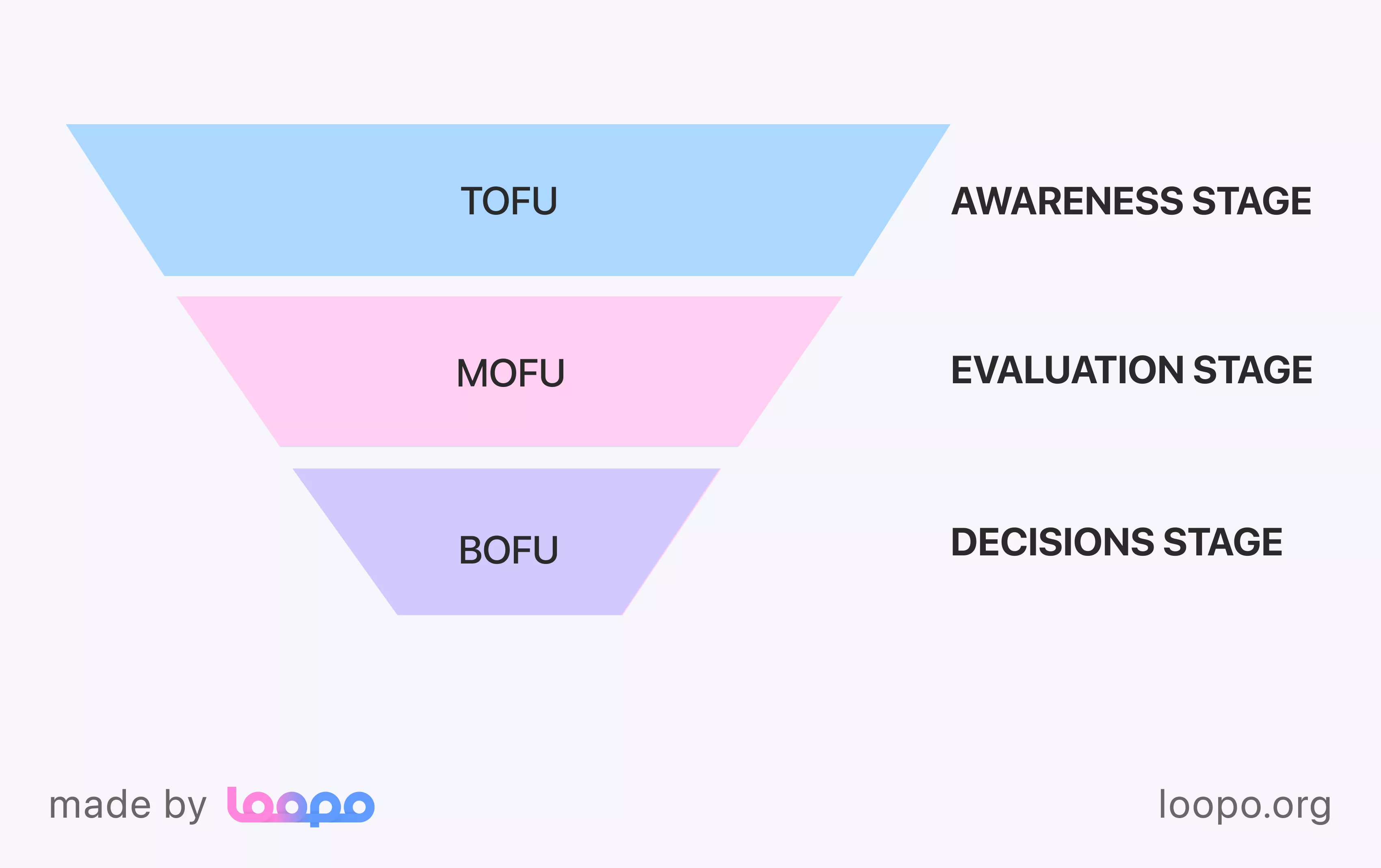
A B2B content marketing funnel is a structured content strategy framework that maps specific assets to three buyer journey stages: top-of-funnel (TOFU) for awareness, middle-of-funnel (MOFU) for evaluation, and bottom-of-funnel (BOFU) for purchase decisions. Each stage answers a different question in the buyer's head. TOFU surfaces the problem. MOFU compares solutions. BOFU justifies the vendor choice.
So why does this framework matter more in B2B than in B2C? Because the buying cycle is dramatically longer and the room is far more crowded. Complex B2B purchases now average 10 to 12 months, and large multinational deals routinely stretch past 16 months — with most stalling at least once along the way.
The other complication is the buying committee. A modern B2B purchase isn't one person clicking "buy." Forrester's 2024 State of Business Buying Report puts the average buying group at 13 stakeholders, while Gartner's range lands at 6 to 10 — and 7% of decision-making units now involve ten or more people from finance, IT, legal, procurement, and the line of business.
That's the core role of content in a B2B marketing funnel. You're not nudging one shopper toward checkout. You're arming an internal champion with the blog post, the comparison guide, the case study, and the ROI calculator they need to win over twelve skeptical colleagues over many months. A B2C funnel collapses in minutes; a content marketing funnel for B2B has to sustain attention, answer objections, and survive committee debate.
Bottom line: the B2B content marketing funnel exists because complex, multi-stakeholder buying demands purposeful content at every stage of the customer journey.
Before building your funnel, it helps to understand exactly why B2B funnels behave so differently from their B2C counterparts.
B2B vs. B2C funnels: key differences
The gap between a B2B and B2C funnel isn't a matter of degree. It's structural. Three forces — cycle length, deal value, and committee dynamics — reshape every content decision you'll make.
Start with timing. B2B sales cycles run roughly 30 days to 18+ months depending on deal size, while B2C transactions close in minutes to days. That single difference explains why B2C funnels can lean on emotional triggers and flash discounts, while B2B typically needs months of educational nurture across multiple types of marketing strategies.
Deal value drives cycle length almost linearly. In SaaS, deals under $5K ACV should close within 30 days, deals under $100K take 90 to 180 days, and contracts over $500K routinely run 6 to 18+ months. Higher price tags trigger procurement reviews, security audits, and budget approvals — each demanding its own content asset.
Then there's the committee. Modern B2B buying groups average 8 to 13 stakeholders, each conducting independent research before group discussions. A B2C buyer talks to a spouse. A B2B champion fights a turf war.
Funnel attribute | B2B funnel | B2C funnel |
|---|---|---|
Cycle length | 40-270 days | Minutes to days |
Decision-makers | 8-13 stakeholders | 1-2 people |
Deal value | $5K to $500K+ | Under $500 typical |
Touchpoints needed | 20+ across months | 3-7 across days |
Content depth | Long-form, gated | Short, visual |
What does this mean for your content marketing funnel? You need more assets, longer sequences, and role-specific messaging — one whitepaper for the CFO, one technical brief for IT, one case study for the operations lead. A single hero piece won't carry you.
Bottom line: B2B funnels demand more content, more patience, and more stakeholder-specific messaging than B2C ever will.
With that context established, here is exactly how the three funnel stages work and what content belongs at each one.
The 3 stages of the B2B content funnel
Each stage of the B2B content marketing funnel maps to a different buyer mindset — and demands different content to match.
TOFU: awareness stage
At the top, prospects know they have a symptom but haven't named the problem. Your goal is discovery, not pitching. Blog posts, thought leadership articles, original research reports, educational video, and social content do the heavy lifting here — distributed through organic search, LinkedIn, and YouTube, where the SEO benefits for B2B content compound over time. Original research reports earn outsized attention because they're repurposable into MOFU webinars and whitepapers later.
MOFU: consideration stage
MOFU is where buyers start comparing solutions and where you start capturing leads. Case studies, comparison guides, webinars, email nurture, and whitepapers belong here. This is your primary lead generation gate — gated content traded for an email and a job title. MOFU assets typically convert at 2–5%, and that's where most SaaS funnels make or break pipeline.
BOFU: decision stage
By BOFU, buyers have shortlisted vendors and need ammunition to defend the choice internally. The types of bottom-of-funnel content B2B marketing teams should ship: free trials, demos, ROI calculators, customer testimonials, product pages, and competitor-alternative pages. BOFU comparison pages convert at over 7.5%, nearly 4x the average landing page.
Here's the thing: skip any stage and the customer journey breaks. A prospect reading your awareness-stage blog won't request a demo cold. A buyer ready for sales won't sit through another educational webinar.
Bottom line: match content format to buyer mindset at every stage of the content marketing funnel, or watch leads stall.
Now that you understand what each stage requires, here is a practical process for building your own funnel from scratch.
How to build a B2B content marketing funnel
Building a content marketing funnel that actually drives pipeline comes down to five concrete steps. Skip one and the whole structure wobbles.
Step 1: Define your ICP across four layers
Build your ideal customer profile with firmographic, technographic, behavioral, and signal-based layers — then validate it against closed-won data quarterly. A static slide deck won't cut it; embed the ICP as a dynamic scoring model inside your CRM so your target audience definition stays current.
Step 2: Map content formats to each stage
Match assets to ICP pain points and buying triggers. TOFU gets blog posts and research reports. MOFU gets case studies, comparison guides, and webinars. BOFU gets demos, ROI calculators, and competitor-alternative pages. Use a product marketing framework to align each asset with a specific stage and stakeholder concern.
Step 3: Assign distribution per stage
Channels carry the load differently at each stage. TOFU runs on organic search, LinkedIn, and YouTube. MOFU lives in email nurture, gated content, and webinars. BOFU pulls weight through paid retargeting, sales outreach, and product-led trials.
Step 4: Build lead capture and nurture sequences
Gate MOFU assets, then trigger 4-7 step email sequences using a 3:1 value-to-ask ratio — three pieces of value before any sales ask. Nurtured leads purchase up to 23% faster and respond 4-10x more than blast emails, making this the highest-impact piece of most content marketing strategies.
Step 5: Define per-stage metrics in a shared dashboard
Set TOFU, MOFU, and BOFU KPIs — then put them in one CRM dashboard both marketing and sales watch daily. Shared definitions kill the lead generation finger-pointing.
Want every stage of your funnel running from one place? Start your free trial and manage all your content in one place.
Bottom line: five steps, executed in order, turn scattered content marketing strategies into a measurable revenue engine.
Once your funnel is built, you need to know whether it is actually working — which means tracking the right metrics at each stage.
Metrics to track at each funnel stage
A single aggregate conversion rate hides exactly where your content marketing funnel is bleeding leads. Track distinct KPIs at each stage or fly blind.
TOFU metrics: visibility and capture
At the awareness stage, watch organic traffic, impressions, social reach, and visitor-to-lead conversion. Benchmark visitor-to-lead at 2-5%, with top 10% hitting 8-15%. Use organic search analytics to track pipeline and revenue per SEO session — not just rankings.
MOFU metrics: qualification depth
Mid-funnel is where most B2B funnels break. Track MQLs, email open rates, content downloads, time on page, and MQL-to-SQL conversion. A healthy MQL-to-SQL rate typically sits at 25-40%, while the overall B2B median lands at just 13-15%. Below 15% signals weak lead scoring or misaligned definitions between marketing and sales.
BOFU metrics: revenue signals
At the bottom, track SQLs, demo requests, demo-to-opportunity rate (benchmark 60-80%), conversion rates, and deal velocity. These are the numbers your CFO actually cares about for measuring marketing ROI.
Watch channel and segment variance
Aggregate numbers lie. SEO-sourced leads convert at 51% MQL-to-SQL while PPC sits at 26% — a nearly 2x gap from the same funnel. B2B conversion rates also vary heavily by industry, so benchmark against vertical peers, not universal averages.
One operational metric matters across every stage: follow-up speed. Leads contacted within one hour convert at 53% MQL-to-SQL versus just 17% after 24 hours. Your content can be perfect, but a slow handoff to sales kills the math.
Bottom line: per-stage KPIs in a shared CRM dashboard turn vague pipeline anxiety into specific, fixable problems.
Knowing what to measure also means knowing what mistakes will distort those numbers — here are the most common funnel errors to fix.
Common B2B content funnel mistakes to avoid
Most B2B content marketing funnel failures trace back to five predictable errors. Fix these and pipeline math improves fast.
Mistake 1: Over-indexing on TOFU
A content audit of 40+ B2B software sites found over 70% of their content targets purely informational keywords — even though commercial-intent keywords convert roughly 10x higher. Awareness traffic feels productive. It rarely closes deals.
Mistake 2: Failing to align content to buyer role
A CFO needs ROI math. A technical lead needs integration specs. A procurement officer needs security documentation. Publishing one generic asset and hoping it lands with every persona ignores how committees actually evaluate vendors — and leaves your champion empty-handed in internal debates with the rest of the target audience.
Mistake 3: Not measuring per-stage metrics
Aggregate funnel numbers mask where prospects drop off. If you only track total conversions, you can't tell whether MQL quality is weak, sales follow-up is slow, or BOFU pages aren't closing. Per-stage KPIs are the only way to diagnose the actual leak.
Mistake 4: Treating the funnel as linear
B2B buyers average 27 touchpoints across channels and devices, with roughly 80% of the journey self-directed. They loop back to TOFU after seeing pricing. They jump to BOFU before any nurture email lands. Your content marketing strategies need to assume non-linear access — every asset discoverable, every stage navigable on demand.
Mistake 5: Neglecting BOFU objection-handling content
Assuming MOFU nurture alone closes deals is the most expensive mistake of all. Buyers at the decision stage need ROI calculators, competitor comparisons, security pages, and implementation timelines. Without them, your champion can't defend the choice — and the deal stalls.
Bottom line: most content marketing funnel leaks are diagnostic, not creative — fix the structural errors first.
Beyond avoiding these mistakes, the most durable funnel improvements come from direct campaign experience — here is what we have observed building B2B content funnels in practice.
What we've seen work: lessons from real B2B content funnels
Across years of B2B content campaigns — including SaaS clients running 6 to 9 month sales cycles — one finding repeats more than any other. Funnel performance improves fastest when MOFU content is prioritised before TOFU volume is scaled.
Why? Because most teams arrive with the opposite instinct. They want more blog posts, more impressions, more traffic. But when conversion rates are low and cycles are long, pouring traffic into a leaky middle wastes budget. The fix isn't more awareness content. It's better evaluation-stage content.
In practice, the highest-impact assets for SaaS clients with extended sales cycles have consistently been case studies and webinars. A well-built case study — specific metrics, named customer, honest implementation timeline — gives an internal champion something they can forward to a skeptical CFO. Webinars that pair a customer story with a product walkthrough compress weeks of objection-handling into 45 minutes. Both function as pipeline accelerators in ways that no TOFU blog post can match.
The other lesson is uncomfortable. Fewer than 4% of B2B marketers measure content impact beyond six months, despite roughly half of B2B buyers taking six months or more to purchase. That mismatch causes teams to kill MOFU programs that were actually working — they just hadn't matured yet. Whatever B2B content marketing agency sales funnel approach you adopt, extend your measurement window or you'll misread your own performance.
The pattern holds across verticals. Build the middle first. Layer awareness on top once MOFU conversion is healthy. Then scale lead generation volume against a content marketing funnel that actually closes.
Bottom line: prioritise MOFU depth before TOFU breadth, and measure long enough to see what's working.
Here are concise answers to the most common questions marketers ask when implementing a B2B content funnel.
Wrapping up: build a funnel that actually closes
A B2B content marketing funnel works when each stage carries its own weight — TOFU surfaces problems, MOFU earns the consideration, BOFU defends the decision inside a 13-person committee. Skip a stage and pipeline stalls. Measure only aggregates and you'll misdiagnose every leak.
Here's the thing: don't chase more blog posts before fixing your middle. Build MOFU depth first, layer TOFU breadth on top, and extend your measurement window past six months so you can actually see what's working.
Want more practical playbooks like this one? Browse our blog for deeper walkthroughs on content strategy, distribution, and measurement.
Ready to run every stage from one place? Start your free trial and manage all your content in one place.
Bottom line: structure beats volume in every B2B funnel.