What Is Domain Authority? A Clear Explanation


Domain authority is a score from 0 to 100, created by Moz, that predicts how likely your website is to rank in search results. Higher scores suggest stronger ranking potential, but it's a third-party estimate — not a metric Google publishes or uses.
I'm Max, and I've spent many years helping marketing teams cut through tool overload and build content systems that actually stick. You've probably seen DA tossed around in SEO reports, pitched in guest-post emails, or flagged in competitor audits. It's useful — when you know what it's really telling you.
Here's the thing: most marketers either obsess over the number or ignore it entirely. Neither approach helps. Let's start with the short, straight answer.

Domain Authority: The Short Answer

Domain authority is a score that predicts how well your website might rank in search results. It runs on a scale from 0 to 100, where higher means stronger ranking potential. Moz created it, which makes it a third-party metric — not something Google publishes or uses directly.
So what is domain authority in SEO terms? Think of it as a credit score for your website's reputation. New sites start near the bottom. Older sites with quality backlinks and steady traffic climb higher over time.
A quick reality check before you panic about your number. Domain authority isn't a Google ranking factor. It's a prediction tool built by an outside company to estimate how you stack up against competitors. Marketers typically use it to benchmark progress, compare sites, and spot link-building opportunities.
You'll also hear about authority scores from tools like Ahrefs and Semrush. Each uses its own formula, so scores won't match across platforms. That's normal. Pick one and track it consistently.
Bottom line: understanding domain authority means knowing it's a useful yardstick, not a verdict from Google. To understand what the score actually reflects, it helps to know what goes into calculating it.
How Domain Authority Is Calculated

Moz builds your domain authority score by running dozens of signals through a machine-learning model. The biggest input? Backlinks. The model weighs both how many sites link to you and how trustworthy those sites are.
Quality beats quantity here. One link from a known industry publication can outweigh fifty from random blogs. Moz also counts linking root domains — unique sites, not repeat links from the same source.
So what is domain authority actually measuring? In most cases, it compares your link profile against sites ranking well in Google, then predicts where you'd land. The model gets retrained periodically, which means your score can shift even when nothing changed on your end.
Here's what trips people up: the scale is logarithmic. Moving from 20 to 30 is far easier than moving from 70 to 80. A small niche blog might see substantial early gains from press mentions, then progress slows considerably as scores climb higher.
Page authority versus domain authority? Page authority scores a single URL; domain authority scores the whole site. Same signals, different zoom levels.
Bottom line: your score reflects backlink profile strength, and gains slow as you climb. Next question — what score should you actually aim for?
What Is a Good Domain Authority Score?
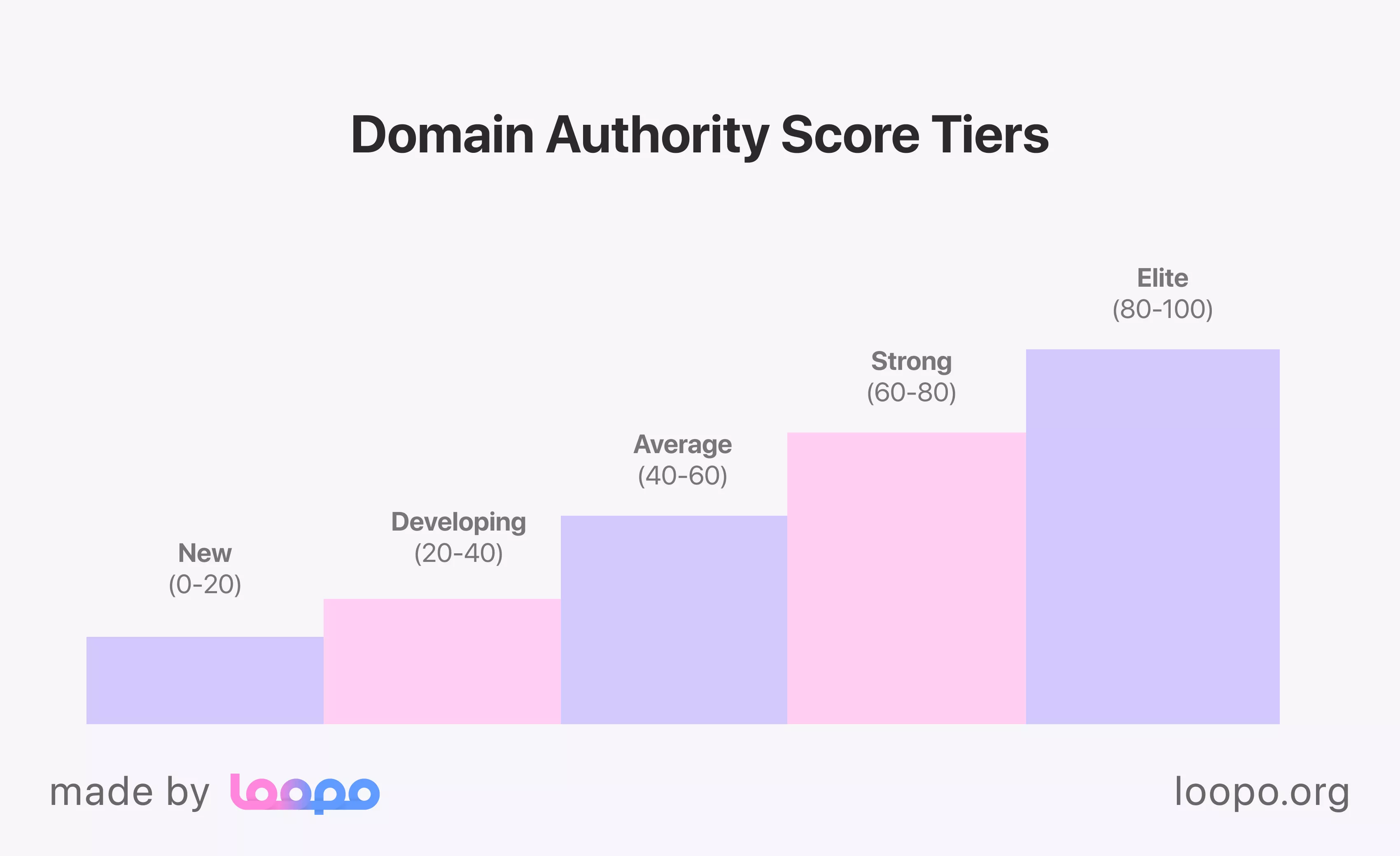
So what is a good domain authority score? It depends entirely on who you're up against. A local plumber doesn't need the same score as HubSpot.
Most marketers think about the scale in rough tiers. Under 20 is new or thin. The 20–40 band is developing. Scores of 40–50 sit in average territory for established sites. Hit 50–60 and you're in solid shape. Above 60 is strong. Past 80? That's reserved for major publishers and household-name brands.
But what is good domain authority, really? The score that beats your direct competitors in search. If three rivals sit at 35 and you're at 45, you're winning that race regardless of the absolute number.
DA range | Tier | Typical site |
|---|---|---|
0-20 | New or thin | Fresh domains |
20-40 | Developing | Small business sites |
40-60 | Average to solid | Established brands |
60-80 | Strong | Industry leaders |
80-100 | Elite | Major publishers |
Check your top five organic competitors. That's your real benchmark.
Bottom line: a good domain authority score comes down to beating the sites you actually compete with. Knowing where you stand is only useful if you understand why the metric matters for your broader SEO efforts.
Why Domain Authority Matters for SEO

Here's the thing: domain authority isn't a Google ranking factor. Moz is a third party, and Google has said plainly it doesn't use DA to decide who ranks. So why track it at all?
Because it's a fast, consistent signal. You can pull a score in seconds and compare sites on equal footing. That makes DA genuinely useful for two jobs inside your SEO strategy.
First, benchmarking. Watching your score climb over months tells you whether your link building is actually working. Second, prospecting. When a guest-post pitch lands in your inbox, DA gives you a quick read on whether the site is worth your time.
So what is domain authority and why does it matter for day-to-day work? Picture a SaaS marketer weighing ten outreach targets before lunch. DA sorts them fast. That's the real win.
You'll still want to look at traffic, relevance, and spam signals before committing. But as a starting filter, DA saves hours. Pair it with the benefits of SEO for your business and you've got a practical authority check — not a vanity metric.
Bottom line: domain authority matters because it helps you measure progress and vet partners quickly. Once you understand why it matters, the logical next step is knowing how to check your own score.
How to Check Your Domain Authority
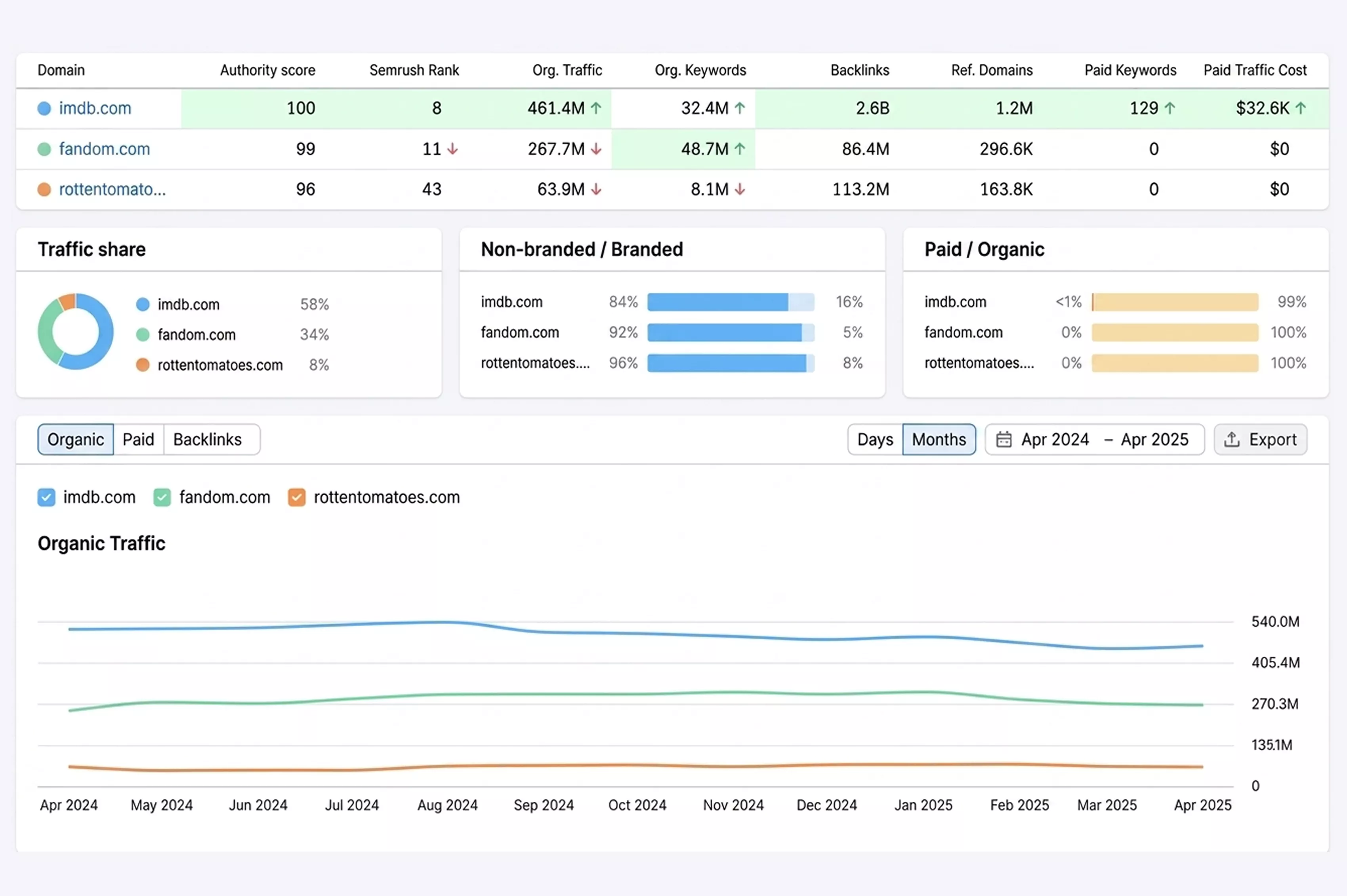
Pulling your domain authority score takes under a minute. Head to Moz's free Link Explorer, drop in your URL, and you'll see your DA alongside linking domains and top pages. No signup needed for basic checks.
Prefer a browser-based view? Install the MozBar Chrome extension. It shows DA and PA on every site you visit, which is handy for sizing up competitors or guest-post targets on the fly.
Want a second opinion? Ahrefs Website Authority Checker and Semrush Authority Score give you comparable numbers using their own formulas. Don't worry about the mismatch between tools — just pick one and stick with it.
The real value isn't the snapshot. It's the trend. Check monthly, log the number in a spreadsheet, and watch it move alongside your link-building work. Pair that with how you track your organic search performance and you'll spot what's actually driving gains in your SEO strategy.
Bottom line: free tools give you the number in seconds, but tracking it over time is what makes it useful.
Knowing your score is the starting point — the more pressing question for most marketers is how to actually move it upward.
How to Improve Your Domain Authority
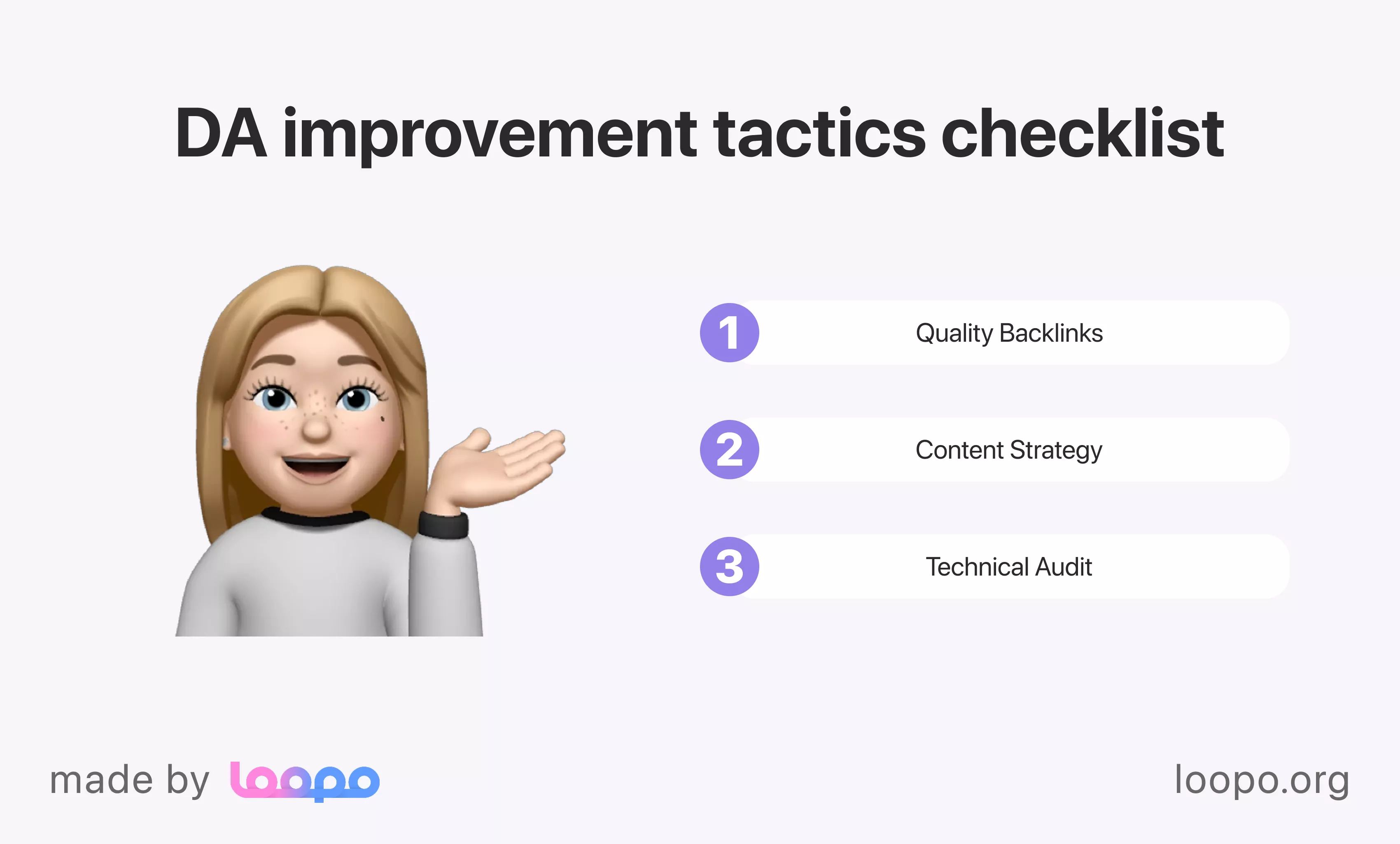
Raising your score comes down to earning quality backlinks from different domains while keeping your technical house in order. That's the short version.
Focus your link building on relevance first, authority second. A link from a respected site in your niche typically beats a high-DA link from an unrelated blog. Guest posts, original research, and digital PR still work — when you pitch real value instead of spam.
Audit your existing links quarterly. Disavow clearly toxic links, fix broken internal links, and make sure your fastest-loading pages are the ones earning attention. A simple content strategy framework keeps your publishing focused on topics that naturally attract citations.
Want to skip the tool chaos and run outreach, publishing, and tracking from one place? Start your free trial and manage all your content in one place.
Bottom line: distinct-domain links plus clean technical foundations move the authority needle.
Theory is useful, but seeing how these levers play out in practice is where the real lessons live.
What We've Seen Work: Lessons From Real Campaigns
The clients who moved their domain authority fastest all did one thing the same way. They treated link building as a standing weekly task, not a quarterly scramble.
Picture a B2B SaaS team we worked with. They dedicated a consistent weekly block of time to outreach, guest-post drafts, and podcast pitches. Nothing fancy. Their score roughly doubled over less than a year while a competitor doing the same work in bursts barely moved.
What made the difference? Consistency compounds. A handful of pitches per week sustained over a year outperforms a large burst of outreach crammed into a single month. Editors remember steady names. Relationships mature. Links trickle in even on weeks you don't pitch.
Pair that rhythm with a clear product marketing framework so every piece you publish has an angle worth linking to. Random blog posts rarely earn citations.
Bottom line: schedule link building like payroll and your authority score follows.
With a clearer picture of both the theory and real-world application, let's address the questions we hear most often.
Wrapping It Up
So what is domain authority in the end? It's a third-party score that estimates your site's ranking potential — not a verdict from Google. Use it to benchmark against competitors, vet link partners, and track whether your SEO work is paying off over time.
The fundamentals never change. Earn quality backlinks from varied domains, publish content worth citing, and keep your technical foundations clean. Consistency beats bursts every time.
Want more practical playbooks like this one? Head to our blog for deeper guides on content strategy, SEO, and team workflows.
Ready to stop juggling tools and run your content operation from one place? Start your free trial and manage all your content in one place.
Bottom line: track DA, but build the habits that actually move it.